 LIMBO-You know what limbo means—of course you do—you’ve probably used that word hundreds of times. It means hanging on the edge, awaiting a decision from someone else—unable to make a move or a decision until a certain question is resolved etc. But do you know what it means in religious terms?—I don’t recall hearing that term used from any pulpit in the Catholic Church for fifty years. But that was not always the case.
When I was a small child being lectured daily in the Catechism of the Catholic Church, Limbo was a dramatically important consideration. It was a hand-wringing, gut-wrenching subject of major, major concern. It was so important that baptisms had to be performed on infants very soon after birth—usually one week. In fact, it was so important that even the slightest hint of a baby’s lack of viability at birth or immediately thereafter mandated immediate baptism by whomever was in attendance—no matter what. Years later, as both a medical student and practicing physician delivering babies, that mandated urgency still prevailed. I, personally, don’t ever recall the perceived need to baptize any baby—as a senior medical student, I did in fact deliver fourteen babies in one night at Saint Louis City Hospital #1. Altogether, during my Medical School, post graduate training years and two years of private practice (Family Medicine), I’d estimate that I delivered 300-400 babies—none were in extremis or showed signs of unviability.
 If you are not an older Catholic, or if you are non-catholic, you may not have a clue as to where I’m going with this. Where I’m going is this: the psychological trauma impaled on young children and perpetuated into adulthood was/is both scandalous and shameful. You see, an unbaptized infant who died had absolutely no possible chance of getting into heaven. In fact they were perched in a special place called Limbo right on the edge of Hell—the word limbo comes from ‘limbus’, meaning edge or precipice. Oh they were happy, but only ‘naturally’ happy—-they could never, ever enjoy the beatific vision because they still had the stain of Original Sin.Who in his right mind would want an innocent baby to be subjected to such denial? Do you now understand the hand-wringing, gut-wrenching urgency for baptism—I can still remember the anxiety I experienced just thinking of all the babies in the world who died without baptism—there had to be millions, because most people never even heard of Jesus and Baptism.
So where did the concept of Limbo come from in the first place? Well consider this, the same people who came up with the idea of Original Sin, concocted the idea that Baptism was absolutely necessary for admission into heaven. Those two ideas created an immediate dilemma—what were they going to do with all the babies dying unbaptized—they had to have a rational sounding ‘place’ for them—so they dreamed up Limbo. Augustine, Jerome and the likes were the ‘granddaddies’ of Limbo.
You might ask,’what difference does it make, and I’ll say ‘one hell of a difference’. I spent the first thirty five to forty years of my life worrying about such ‘nonsense’. It was years later that I learned that the concept of Limbo was not official dogma of the Catholic Church—each Bishop could teach it or not according to his whelms. It just so happens that the first Bishop of the Owensboro Dioceses under whom I was instructed was Bishop Cotton, An Opus Dei par excellence. He liked Limbo—he loved torture.
 So what do we have now? I haven’t delivered a baby since 1967 and I don’t have a clue as to what Catholic nurses are being taught nowadays. What I do know is this. What, once upon a time, was a sober exercise, performed in private within about a week of birth, now has turned into a ‘gala affair’ performed 2-4 months post partum.
Also, not even a whisper of Limbo—I wonder why— I think I know. People are dropping away from religion like dead flies falling off the wall. All austerity must be eliminated. The hierarchy aren’t dumb—they can see what’s happening. They know that the younger set will never take the time and energy to research church history, and they sure as hell aren’t going to volunteer it to them—how many times have you heard a sermon about the Inquisition, or of the selling of indulgences, or of all the bad (horrible) popes?—I’ve never heard a single one and I’m 86 years old. They know that soon enough all the ‘old heads’ who remember all that crap will soon enough be gone—so they keep ‘mum’—-they ‘sweep it under the carpet’—-it never happened. Its a ruse ‘older than God’.
Guess what—-we old heads are still hanging in Limbo—likely, you are also and just don’t know it.
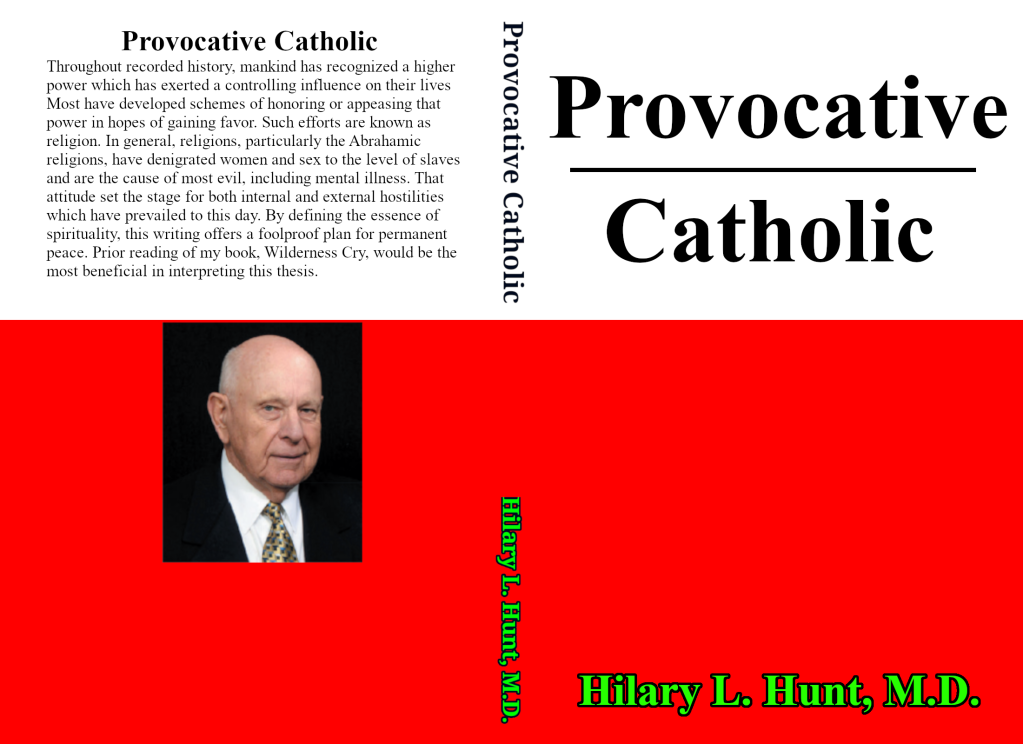
My two little books Wilderness Cry and Peace in Spirituality explain all. I am attaching Covenant Books’ Press release and video trailer for each. If you got questions, you’ll find the answers there.
906242_Press Release for Wilderness Cry
Press Release for Peace in Spiritiality
 HELL-FIRE AND DAMNATION—how many times have you heard those predictions and where did those dire proclamations come from—well from your preacher, of course—where else? Could you have ‘guessed’ it on your own?—possibly, but not likely. It is very likely that no rational person, realizing that he/she had been born into a world, not of its chosing could ever imagine of such. So where did such ideas come from? Well, we have to go to the bowels of religion to find that answer. From the earliest days of recorded history, mankind has ‘imagined’ a ‘higher power’ who exerted control over their lives. Some saw that power in the wind, others in the water, some in the sun, others in the moon.
 The poor peasants would bring their ‘imperfect offerings’ and the High Priest would take them for little barter. In exchange, they had to pay the High Priest a ‘pretty penny’ for his ‘prefect offering’, whilst he literally ‘stole’ their hard earned offerings. Jesus took note of that—in addition, he took great exception to that practice. He became so irate as to overturn their money-changing tables and called them out as hypocrites—that, among other things, got him killed—-they hung him on a tree for all the world to see. Thank God for Jesus.
 JESUS, OUR BROTHER– Somewhere in one of the hymns we sing at Catholic mass, Jesus is referred to as ‘our brother’. I have often wondered how Catholics in general consider that notation—or if they consider it at all. So many hymns and prayers are oft repeated so as to become ritualistic—memorized and repeated without specific thought or attention to meaning. Its much more fun to be critiquing someone’s dress, or hair-do, or replaying the winning hole of golf from yesterday’s game, than to be concentrating on the boring ritual of memorized prayer or song.
 So, how bad were the Jews? I’d vouch to say no worse than any other society that ever existed including ours’ right here in the good old USA. Jesus simply used his fatherland brethren as a vehicle for executing his plan and purpose. He had to die—he saw himself as the messiah, the sacrificial lamb who would exonerate us all—he did. Thank God for Jesus and for the Jews!!!!!.
 All my books are now available from Amazon-Kindle, both hard copy and digital. Also available, autographed, from me (handg@comcast.net)
 SACRIFICE- now here’s a word that imparts a feeling of dread and drudgery, and well it should. How many times in our daily lives we are called to sacrifice our time, energy, talents and money for others. Most often it is for our family members, but frequently it may be for neighbors, friends or even total strangers. The question is ‘why do we do that?’. One might answer in various ways—sense of duty, sympathy, empathy (do unto others….). Regardless of the exact reason or attitude, sacrifice is always done because of one basic value and that is love.
 So what’s my point—don’t allow yourself to get caught in the trap of judgmentalism. Just because a person may seem to you to be insensitive, it may not be the case at all. Just because you as a specific individual may think of yourself as being extremely self-sacrificing, never allow yourself to be critical of other’s seeming disregard. Remember, all of your sacrificial activity carries with it a trail of selfishness—you get sense of self-satisfaction. Be careful not to let yourself be perceived as a do-gooder or, worse yet, holier than thou.
 My take is simply that ‘its all wrong’. My God is Perfect Rationality. He/she/it exists in eternity. Eternity is a state if being where there can be no change (time). God, being perfect, cannot possibly be pleased or hurt—allowing such would expose an imperfection. Jesus was the ‘only’ sacrifice of consequence. Jesus was genius—he saw the universal evil of selfishness—he recognized that the Spirit of God was in everything including him—he saw that in order for God to show his ‘perfect love’ to the world, he, Jesus must die in atonement for all the evil in the universe. He did so graciously but not without great fear and anguish—I can’t imagine such. God is heaven. We and everything in existence are in God and of God.

 WILDERNESS CRY by Hilary L Hunt MD