 HELL-FIRE AND DAMNATION—how many times have you heard those predictions and where did those dire proclamations come from—well from your preacher, of course—where else? Could you have ‘guessed’ it on your own?—possibly, but not likely. It is very likely that no rational person, realizing that he/she had been born into a world, not of its chosing could ever imagine of such. So where did such ideas come from? Well, we have to go to the bowels of religion to find that answer. From the earliest days of recorded history, mankind has ‘imagined’ a ‘higher power’ who exerted control over their lives. Some saw that power in the wind, others in the water, some in the sun, others in the moon.
 Sooner than later (fourteen thousand years ago), the astute Egyptians connected the dots between the stars and created the Zodiac (animals). They observed that each of its’ twelve characters gradually ‘rotated off the horizon. They even calculated the time for that rotational shift to be between eighteen hundred and twenty two hundred years—each such time period was known as an age. Likely we modern humans think of them as generic ignoramouses, but, in reality, they were brilliant—their calculation of near twenty six thousand years for the complete rotation of the Zodiac characters has stood the test of time—they were indeed pretty smart dudes.
Be that as it may, they also concocted schemes of a Higher Power(s) who exerted influences on their existences. They were so convinced of those Power’s influences that they became sacred and inviolable—later on the most affected were the Pharos who earned such a relationship as to become immortal—they escaped the throes of eternal punishment—total extermination with no possibility of immortality. Later on, that philosophy became the routine especially when Christianity hit the scene.
The Jews, who had been captive to the Egyptians for at least forty years, incorporated some Egyptian philosophy into their ‘Religion’—-they had Baptism, and the Jews liked that arrangement, not because it imparted eternal bliss but because it secured special favors from the gods. However, the Jews didn’t want to be bothered with three dozen gods—they were satisfied to bargain with ‘one God’—and bargain they did. I mean, before it was all over, they had God ‘down on his knees’—such was their bargaining power. They made God agree to every wish they could think of—problem was, they couldn’t trust God. Even though they carried God around on their shoulders, they really couldn’t trust him—he had to be appeased.
Their sacrifices went so far as to be ‘human’ in nature in some circles—young girls were the most favored—I wonder why. Mind you, the Jews didn’t offer such sacrifices, but their mimickers did. The Jews discovered a ‘handsome’ benefit to offering sacrifice. They established a hierarchy of sorts and only the High Priest could ‘offer sacrifices’ of appeasement. This arrangement became vey financially beneficial for the hierarchy, especially the High Priest. Each offering had to be ‘perfect’, and only the High Priest could provide such ‘perfect offerings’.
 The poor peasants would bring their ‘imperfect offerings’ and the High Priest would take them for little barter. In exchange, they had to pay the High Priest a ‘pretty penny’ for his ‘prefect offering’, whilst he literally ‘stole’ their hard earned offerings. Jesus took note of that—in addition, he took great exception to that practice. He became so irate as to overturn their money-changing tables and called them out as hypocrites—that, among other things, got him killed—-they hung him on a tree for all the world to see. Thank God for Jesus.
Now fast-forward three hundred twenty five years or so. Jesus’ followers paid no heedence to his teachings—well so it seems. By the time Constantine became Emperor of Rome, Mithraism was the official state religion. That cultist practice, similar to Christianity had sacraments, priests (Mithras), and sacrifice. People’s sins could be abolished by allowing the blood of a sacrificed bull spill onto them. They would stand under an elevated platform onto which a bull would be led. The Mithra would then stab the bull in the neck—the blood spilling through the cracks onto the penitents had a ‘cleansing ‘ effect. The Romans ‘loved’ Mithraism.
The Christians, however, who were under Roman domination and were supposed to be producing for the empire—they had come under the influence of a Jesus religion loosely known as Christianity. The problem was that they were squabbling and even fighting among themselves about who Jesus was and what he ‘said and did’. Their differences were so great as to detract from their productivity for the Empire. Constantine, sizing up the situation, realized he would be better off making Christianity the new ‘State Religion’ rather than attempt to quell the tide of fighting Christians—after all they were the peasants supporting the empire. Accordingly, he called the first Council at Nicaea.
Of the Eighteen hundred or so ‘bishops’ (a bishop was the most influential man in his community) in the world, only two hundred or so attended. Constantine ‘Commissioned’ them to formulate a Christian religion to their liking—it would be the new State Religion enforced by the Roman Army—anyone who rejected the new religion would have two choices—exile to the wild animals or beheading.
The conclave haggling extensively, excommunicated some bishops and twisted the ears of others so forcibly as to make them holler ‘calf-rope’. Eventually, a consensus was reached and a new Human Christianity was adopted by the Holy Roman Empire—many, including me, would say ‘that was the downfall of humanity’—they were much more peaceful with many gods. However, history is history.
In spite of the fact that Jesus taught forgiveness and love, the Religion that eventuated incriminated everyone. The newly created hierarchy were the sin police— they totally ignored Jesus’ and Paul’s teachings, but rather put themselves in the all powerful position of being ‘judge and jury’—eventually all hell broke out. Why?
As best can be determined, the reasons were twofold. First, Luther and others could see the terrible abuses of the Church. However, in stead of correcting those abuses, they created more. While Jesus saw himself as the “sacrificial lamb’ who died for all evil, the Jewish Christians who formulated the early church saw Jesus as some kind of abatement, but not complete— sacrifice was mandated—hence, some two hundred and seventy years or so later, we got ‘the sacrifice of the mass’. The renegades, however were not about to relinquish the role of the High Priest completely. The near mimickers of the Catholics maintained a sacrificial offering service. The so-called Evangelicals turned to a Tenth century translation of a book so contaminated as to be almost dangerous to touch for their ‘God’. And so now we have thirty three thousand versions of a god no one knows but everyone talks about—guess what—they all are money machines—-where in the hell is Jesus now? we desperately need Jesus to overturn the money-changers tables.
Jesus and Paul told us that Love of God and neighbor is all that’s required. The preachers will tell you post-haste that hell can be avoided only by observing the precepts of their church. And the hierarchy live in splendor—they rub elbows with ‘famous people’; they’re on TV daily hob-knobbing with the ‘rich and famous’—what did Jesus say? I don’t recall him hob-knobbing ever with them—seems to me like he despised them. They all preach Hell-fire and Brimstone to us and why? I think just like the Jewish Kings and High Priests—money, power, ,control.
Your God and my God is Perfect Love, just as Jesus and Paul asserted—-There is no Hell—-only God’s perfect accepting Love.
If you want clarification please read my two little books, Wilderness Cry, and Peace in Spirituality—available hard-copy and e-books all major outlets. Covenant Books Press release and video trailer of each attached.
906242_Press Release for Wilderness Cry
Press Release for Peace in Spiritiality
 TRINITY GOD-Most Likely, whether or not you are a so-called Christian, you have heard of Trinity God. More than likely, if you are Christian, you have used some version of that expression hundreds, maybe thousands of times. Most of us have been so inculcated with the term that we use it without even thinking about what we’re really saying—as a matter of fact, we can’t realistically think about what we’re saying—we’ve been told emphatically that its a mystery and is unintelligible to us mere mortals. In spite of that fact, priests and preachers alike world-wide spit out that term or those terms with such voracious rapidity as to make it seem like common everyday horse-sense knowledge. Everybody knows what the Trinity is—its the Father, the Son and the Holy Ghost, right? Oh yes, but just wait a minute……
 Now that we have defined God’s essence, we are now free to explore its ‘accidents’—accidents are those features that make something the specific one of its kind. That brings us to the ‘second person’ of the Trinity. One may legitimately ask, ‘what would a prefect intellect reflect upon?’ The logical answer would be ‘something perfect’ if it existed. Since the only perfect thing in existence is God’s perfect intellect, he looks inward, and what does he see?—a perfect mirror image of himself. Of course, since everything in the supernatural is living, that image is living—the second person of the Trinity. Wait just one minute, you may say—‘I thought Jesus was the second person of Trinity?’. And I say all of God’s image (creation) is second person—Jesus was the representative of God’s entire reflective creation—he was the only one of us to understand that principle—he assumed the role of messiah for the entire universe. However, collectively the entire universe(s) is a reflection of God’s Perfection.
 JESUS, OUR BROTHER– Somewhere in one of the hymns we sing at Catholic mass, Jesus is referred to as ‘our brother’. I have often wondered how Catholics in general consider that notation—or if they consider it at all. So many hymns and prayers are oft repeated so as to become ritualistic—memorized and repeated without specific thought or attention to meaning. Its much more fun to be critiquing someone’s dress, or hair-do, or replaying the winning hole of golf from yesterday’s game, than to be concentrating on the boring ritual of memorized prayer or song.
 So, how bad were the Jews? I’d vouch to say no worse than any other society that ever existed including ours’ right here in the good old USA. Jesus simply used his fatherland brethren as a vehicle for executing his plan and purpose. He had to die—he saw himself as the messiah, the sacrificial lamb who would exonerate us all—he did. Thank God for Jesus and for the Jews!!!!!.
 All my books are now available from Amazon-Kindle, both hard copy and digital. Also available, autographed, from me (handg@comcast.net)
 SACRIFICE- now here’s a word that imparts a feeling of dread and drudgery, and well it should. How many times in our daily lives we are called to sacrifice our time, energy, talents and money for others. Most often it is for our family members, but frequently it may be for neighbors, friends or even total strangers. The question is ‘why do we do that?’. One might answer in various ways—sense of duty, sympathy, empathy (do unto others….). Regardless of the exact reason or attitude, sacrifice is always done because of one basic value and that is love.
 So what’s my point—don’t allow yourself to get caught in the trap of judgmentalism. Just because a person may seem to you to be insensitive, it may not be the case at all. Just because you as a specific individual may think of yourself as being extremely self-sacrificing, never allow yourself to be critical of other’s seeming disregard. Remember, all of your sacrificial activity carries with it a trail of selfishness—you get sense of self-satisfaction. Be careful not to let yourself be perceived as a do-gooder or, worse yet, holier than thou.
 My take is simply that ‘its all wrong’. My God is Perfect Rationality. He/she/it exists in eternity. Eternity is a state if being where there can be no change (time). God, being perfect, cannot possibly be pleased or hurt—allowing such would expose an imperfection. Jesus was the ‘only’ sacrifice of consequence. Jesus was genius—he saw the universal evil of selfishness—he recognized that the Spirit of God was in everything including him—he saw that in order for God to show his ‘perfect love’ to the world, he, Jesus must die in atonement for all the evil in the universe. He did so graciously but not without great fear and anguish—I can’t imagine such. God is heaven. We and everything in existence are in God and of God.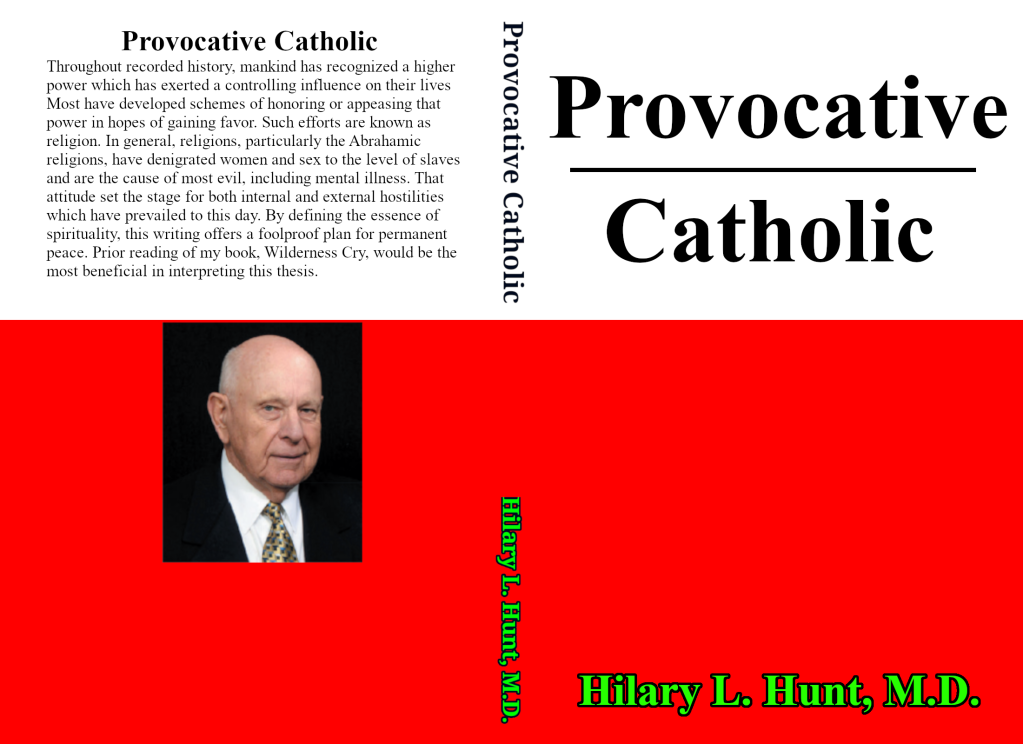


 WILDERNESS CRY by Hilary L Hunt MD