One might be shocked to discover the various usages and understandings of the word Christian. As far as I can determine, the apostle Peter is the first to proclaim Jesus to be the Christ, the son of the living God. The word Christ means ‘anointed one’ or ‘chosen one’ and, even in Jesus’ lifetime, it became understood to imply a king. Remember, at Jesus’ trial, Pontious Pilate, the Roman Procurator who presided, accused or at least noted that Jesus was a king. But Jesus answered by saying, “you say I am a king”.

After Jesus, death, it seems clear that his early followers venerated and portrayed him as a king in their attempts to gain converts. Eventually those followers became known as Christians. However, those Christians told different stories and had different ideas about what Jesus actually said, did, and above all, what he meant. There were no written documents until Paul, a self-proclaimed apostle, began writing letters to his converted communities some fifteen years after Jesus’ death. Some ten to fifteen years later, John Mark, Paul’s companion, wrote the first gospel which contains no genealogy of Jesus and ends abruptly with Mary Magdalyn going to Jesus’ tomb the morning after his crucifixion, finding the tomb empty, and telling no one. Sometime later Matthew, an apostle, and Luke, a Greek convert, copied Mark’s work and embellished it on both ends with conflicting stories.
In addition, and possibly more important, Paul, whose missionary work took him all the way to modern day Portugal, and the apostle James who claimed authority in the East disagreed rather vehemently about what Jesus said and meant. Paul preached that faith in Jesus and Baptism were all that’s necessary for salvation. James, on the other hand, declared that salvation depended upon continued good works, prayer and fasting, in addition to faith in Jesus and baptism, were necessary.
Now, mind you, as so-called Christianity spread in all directions, it basically was promulgated by anecdotal ‘word of mouth’. So, no wonder that three hundred years later there was such a diversity of opinion and understanding of Jesus’ teachings and meanings. Each little settlement had its own bishop who had been consecrated by a superior bishop and who was the supreme interpreter of all things about God and Jesus in his area.
The anecdotal stories varied from one bishopric to another, so, there were frequent disagreements among them. Some of those differences were major and created verbal hostilities with some bishops being excommunicated by ‘higher-ups’. One of the major ‘heretical proponents’ were Arians who denied the divinity of Jesus. They professed that God alone is eternal and that Jesus was a mortal being not equal to the Father. Therefore, the Holy Ghost could not emanate from the Son — only the Father.
The bishops with the greatest number of similar beliefs eventually won out at the 1st council Of Nicaea in 325 AD. So, as in just about everything in the animal kingdom, the biggest and/or most powerful wins. Please note that winning has nothing to do with truth or that they were more correct —just more assertive and stronger. The weaker voices were excluded.
So, here we are near seventeen centuries later, and that dichotomy of righteousness has resulted in the so-called Christian world of being shattered into 45,000 different versions — each claiming to be the only one with absolute authenticity. In other words, all others are heretics. Now, why do you suppose that is?
The answer to that obvious question should reverberate with an astounding roar— ‘not a single one of them has defined the essence of Christianity.’ Not one knows who Jesus really was, what he really said, what he really did, or what his intentions really were— we have no reliable source of information. All we have are the loudest voices of the most outspoken who have systematically dissected Jesus of Nazareth into smithereens.
In my humble opinion, base on extensive research and study, they could not possibly know and understand Jesus because not one of them knew then or knows now who God is. If you do not know God, you cannot possibly know Jesus. By that, I mean you cannot understand what Jesus was saying and doing in the name of God if you do not know God.
As I have pointed out many, many times in my writings, I am the first person in known history to define, irrefutably, the essence of God —God is A Perfect Rational Being. That definition by its very essential nature ‘wipes the platter clean’ of any and all past and present concepts of Jesus and God. If anyone in the basic formative years of so-called Christianity held such a concept of God’s nature, it was ‘drowned out’ by the majority ‘know-it-alls’ and never recorded in reviewable history. The only person, other than Jesus, himself, I am aware of who, by his lifestyle and actions, alluded to such a definition was Saint Francis of Assisi. Had he been blessed with the knowledge of science, he undoubtedly would have succeeded in defining God’s essence — he had the correct mindset.
The foregoing observations should make two considerations obvious. Number one: ‘without an essential definition of God’, understanding Jesus is impossible’. Number two: ‘we can never be one in peace until we all become likeminded in our essential understanding of God — then and only then will Jesus become real and will be accepted by all with the same understanding — the essence of Christianity will become self-evident to all and all will be one in union with God and Jesus.
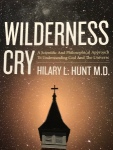
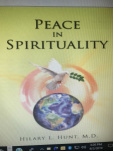
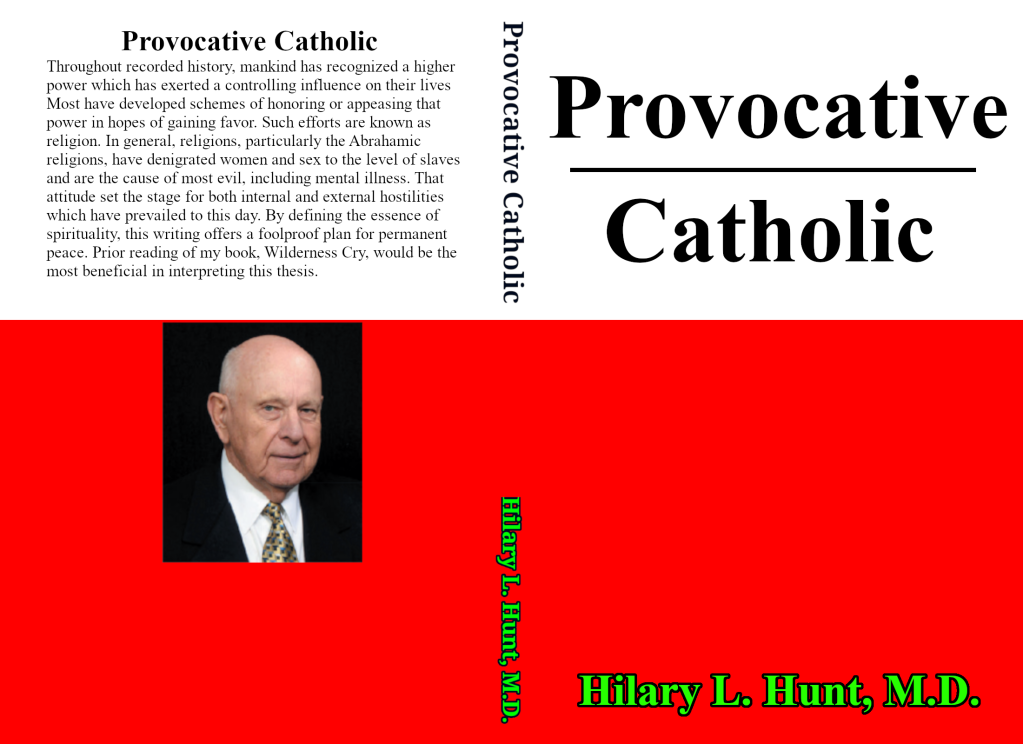
I am fully aware that many have read my theses on these subjects in my three books, Wilderness Cry, Peace in Spirituality, and Provocative Catholic. Maybe, after reading this short dissertation, you will have a better understanding of what my books say and will read them again. If you have not read, I strongly urge you to do so. If you want to know more about me, read my little book Growing Up In Fancy Farm Kentucky. All my books are available Amazon-Kindle, both hardcopy and digital, and from me, autographed at handg@comcast.net. I welcome visitors to my home for purchases and discussions of my books.

Please do not hesitate to comment or ask questions. I will do my best to satisfy your query.
baptism Bible Buddhaism catholic catholic-church catholicism Christianity church Eternity exodus Faith Future of Christianity God God's Will gods Hilary L Hunt MD Hinduism HolyGhost Holy Spirit homily Islam Islam Christianity Jesus Judaism Judaism Buddhism Money moses Philosophy pope-francis Power Religion religions saints salvation Science sin theology The Trinity

 WILDERNESS CRY by Hilary L Hunt MD
If you have not read Wilderness cry, you are missing out.
LikeLike