Today, I will attempt to explain to you and show you why and how each of us is the specific individual, one of a kind, unlike any other who has been or ever will be in existence—it all has to do with choices. So, what is a choice? That question may seem elementary, but a choice is a decision of acceptance each of us makes between the possibility of two options—our intellect always tells our will which is the better of those two possibilities, and our will is duty-bound to accept that ‘better’.
It all began for each of us with the ‘choice’ our parents made to mate and produce us. Together, they imparted our genetic makeup which in itself imparted the framework for much of our choosing—our physique, temperament, IQ, and sex. From that point on, our choices are based on learning experiences, many of which seem to be gained before birth. However, most of our learning experiences occur after birth. In fact, most of our subconscious programming occurs before we become rational (age seven) and sets the stage for most of our prejudicial decision-making for the rest of our lives. Many of those experiences are real and generate real logical choices such as, ‘touch a hot object and get painfully burned, close a door on your finger and it hurts really badly, etc.’ We may not remember that first painful experience, but we instinctively know to avoid it in the future. That same principle applies to prejudicial experiences heaped upon us by well-meaning but severely biased parents, teachers, playmates, babysitters, etc. Those biases, likewise, are stored in our subconscious and form the basis for our decision making (choices) the rest of our lives, and we don’t know why—seldom de we have memory of the events which prejudiced us.
As we enter the realm of rational thinking at about age seven, each of us is already molded into a specific individual, similar to, but vastly different from, all others of all times. At that early age each of us is already afflicted with our own individual set of fears, biases, guilt complexes, anxieties, and delights. From that moment on, each rational choice we make is flavored (prejudiced) by that myriad of subconscious influences of which we are totally unaware. Offer fifty children the same set of possible choices, and even though many will make one choice while the remainder choose the other, no two of them choose for identical reasons. Furthermore, none of them will be aware of the ultimate dictators of their own individual, prejudicial choices — those dictates are mostly subconscious.
Now, nowhere is our prejudicial thinking and acting more overt than in our choice of friends, political parties, and/or religion. There’s an old saying that ‘birds of a feather flock together’, and that saying is absolutely true. Certain people fall into our ‘comfort zone’—we feel ‘at ease’, not threatened around them. Contrarily, we subconsciously avoid certain personality types, places, and things, and we do not know why—simply stated, we are not comfortable around them.
With that understanding, it is easy to see, as we go through life, how and why our choices are influence by our ‘built-in’ and ‘developed’ subconscious personality biases. A truer statement could never be made than this; each of our personalities is the sum-total of all our life’s experiences and the related choices made therefrom.
The great poet, Robert Frost, may not have been an educated psychologist, but he obviously had a keen insight into animal behavior and personality development. Please Google his little poem, The Road Not Taken, and you will understand.
Likely, the person with the greatest insight into human personality development was none other than Jesus of Nazareth. As best we can determine, Jesus had no formal education of any kind, and, if he had, it would have been false, because all presumed knowledge was based on error— the earth was flat and the center of the universe; the sun, moon, and stars exerted controlling influences on everything, God was sitting in some mythical cloud overlording his creation, etc. However, Jesus’ insight told him that God was in everything, including each of us. Furthermore, his insight showed him that each of us was a unique individual with its own set of differences from all others. He clearly understood that peace could be achieved only through our acceptance of each other’s differences. Hence, he gave us two commandments; Love (accept) our God with our all, and Love (accept) our neighbor as ourselves. He knew we could not possibly do one without the other. He never once suggested we must ‘like’ (be sensually pleased by) each other, but he commanded us to ‘love (accept) each other.
Jesus aimed those two commandments at everyone, but, specifically, at the Jewish hierarchy whom he observed to be bilking their constituents, in the name of God, for their own personal gain. Jesus was brave beyond all imagination — the Jewish Hierarchy had him killed for that heresy.
With that understanding, I ask you one simple question; “Has anything changed since Jesus’ day? Has any religion heeded Jesus’ admonition?” If so, I have been unable to discover it. As far as I can determine, Jesus’ command to love our neighbor as ourselves has been totally ignored. In fact, during my ninety years of attending Roman Catholic services, I have heard only one such sermon, and it was delivered by a friend at my personal behest. Additionally, I have not once heard that admonition from any televangelist.
The reason for ignoring Jesus’ command is clear—there is ‘no money’ in love. There is much money, power, and control in the ‘social commands’ Moses used to impale the Israelites. Those who framed Christianity in 325 AD, at the behest of Emperor Constantine, totally ignored Jesus commands, but rather, reverted to the demonizing, controlling, empire building structure of Judaism which was based upon those Moses commands (Ten Commandments). Consequently, nothing has changed since then except the so-called Christianity they created has fragmented into 45,000 money-grubbing branches and sects.
The bishops who formed the Roman Catholic Church made the deliberate choice to ignore Jesus’ commands. Those who followed, made similar choices to the tune of 45,000. Now, look what those choices have wrought—war and more war, threats and fears of even greater wars, human suffering beyond imagination—people feeling empowered to bring their will onto others without regard for their neighbors’ suffering.
When all is said and done, remember this; Jesus made the conscious choice to die so that we might be liberated. Collectively, we rejected Jesus—our choice. Is it our pride, our greed, our lack of love (acceptance)? I’d suggest, ‘all the above’.

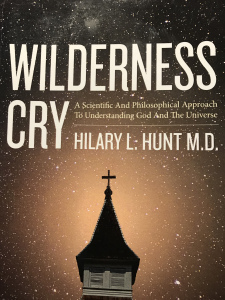
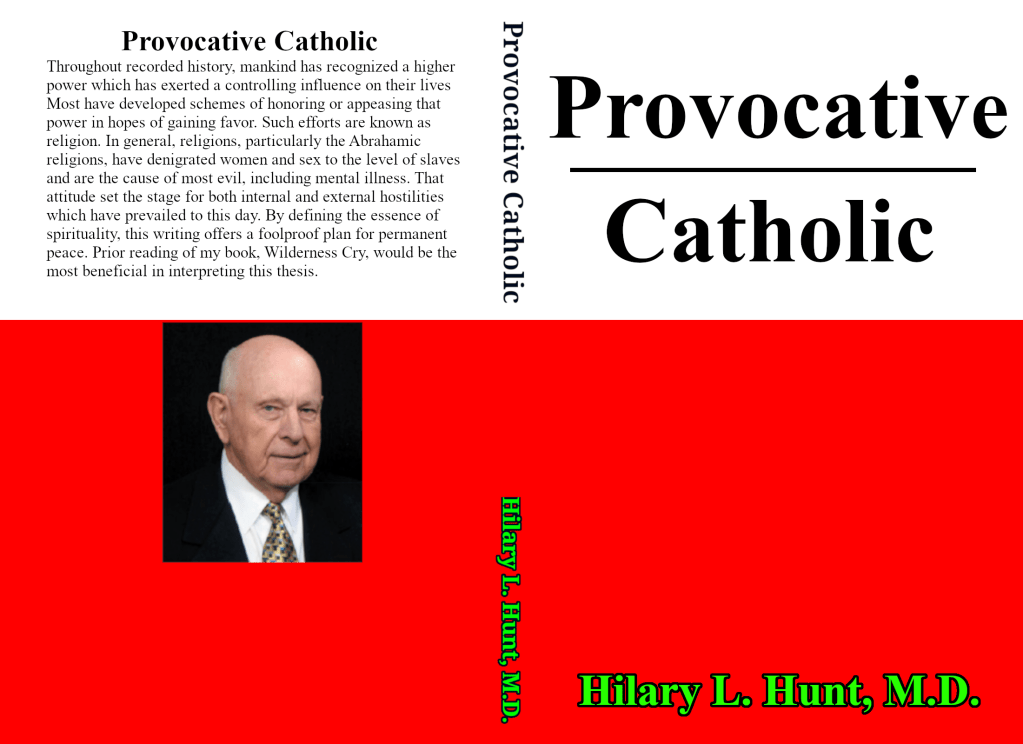
If you have not done so, please read my little books Wilderness Cry, Peace in Spirituality, and Provocative Catholic. Your eyes will be opened. For kicks, you might like Growing Up in Fancy Farm Kentucky.
baptism Bible Buddhaism catholic catholic-church catholicism Christianity church Eternity exodus Faith Future of Christianity God God's Will gods Hilary L Hunt MD Hinduism HolyGhost Holy Spirit homily Islam Islam Christianity Jesus Judaism Judaism Buddhism Money moses Philosophy pope-francis Power Religion religions saints salvation Science sin theology The Trinity

 WILDERNESS CRY by Hilary L Hunt MD